By Kristin Todd, President & CEO, NoCo Foundation
For many working families, finding affordable, high-quality childcare can feel like an impossible puzzle. A parent may find an opening but cannot afford the cost. A provider may want to serve more children but cannot find enough qualified educators. An employer may have jobs to fill, while parents who want to work cannot find dependable care.
These may look like separate challenges. In reality, they are deeply connected.
That idea is at the heart of a recent episode of NoCo Voices, featuring Heather O'Hayre, director of Human Services for Larimer County, and Liz Means, chief strategy officer for Northern Colorado Kids Thrive. Our conversation explores the state of early childhood care and education in Larimer County and the significant community investment now taking shape.
More Than a Family Issue
Childcare is personal. It shapes household budgets, daily schedules, career decisions, and a child's earliest experiences. But it is also essential community infrastructure.
When families can access reliable care, parents are better able to work, pursue education, and provide financial stability at home. Employers can recruit and retain employees. Early childhood educators can build sustainable careers. And young children can learn, grow, and form the relationships that help create a strong foundation for life.
When care is unavailable or unaffordable, the effects ripple outward through families, workplaces, service providers, and the regional economy.
A Community Investment Takes Shape
In November 2025, Larimer County voters approved Ballot Issue 1B, establishing a countywide sales and use tax of 0.25%, or 25 cents on every $100 taxable purchase, to address the shortage and high cost of childcare and preschool. The measure is projected to generate approximately $28 million each year and includes a 20-year sunset.
Larimer County and Northern Colorado Kids Thrive are partnering to translate that public investment into programs designed to:
- make childcare more affordable for eligible families and connect them with support services;
- stabilize and expand the early childhood workforce;
- increase provider capacity through targeted facility improvements; and
- support thoughtful administration, evaluation, transparency, and accountability.
Passing the measure was an important milestone. The next chapter is careful implementation: listening to families and providers, developing accessible programs, measuring results, and sharing progress with the public. The partnership reflects both the urgency of the need and the importance of getting the details right.
Supporting the People Who Provide Care
One of the most important tensions in early childhood care is also one of the hardest to solve: families need care to be more affordable, while early childhood educators, who are already often underpaid, need better compensation and support.
Lasting solutions cannot ask educators to absorb the cost. A stable, skilled workforce requires competitive pay as well as training, coaching, professional development, and pathways for growth. Supporting educators also supports children. When providers can retain experienced staff, children benefit from greater consistency, stronger relationships, and high-quality learning environments.
Facility investments matter, too. Targeted improvements can help providers use their spaces more effectively, improve quality, or add capacity in communities where options are limited.
Seeing the Intersections
The 2024 Northern Colorado Intersections Report: Pursuing Regional Well-Being identified childcare as part of the region's "Sheltering & Caring" intersection, alongside housing, health care, and the needs of an aging population. But this conversation also shows how childcare crosses into other parts of community life, especially workforce participation, financial security, education, and connection.
The report offers a useful reminder: community challenges do not exist in isolation. A childcare opening is also a workforce opportunity. Support for an educator is also an investment in quality and continuity for children. A more manageable monthly bill can give a family greater financial stability. A public-private partnership can turn shared concern into coordinated action.
That is what it means to look at an issue through an Intersections lens: to see not only the immediate need, but the many people, systems, and outcomes connected to it.
What Success Could Look Like
The full impact of this investment will unfold over time. Three to five years from now, success may look like more families finding care that works for their needs and budgets; more educators choosing to enter and remain in the field; providers expanding capacity; and employers experiencing fewer workforce disruptions related to childcare.
Success may also look different across Larimer County. Rural communities, mountain communities, and growing cities do not all face the same barriers. Continued community input, clear evaluation, and transparent communication will help ensure the investment responds to those differences.
Most of all, success will mean that more children have a strong start, and more families have the support they need to thrive.
Larimer County voters made a meaningful shared investment in children, families, educators, and the future of the community. Through thoughtful implementation and strong partnership, that investment can strengthen the fabric of Northern Colorado for years to come.
Want to understand what this investment could mean for families and providers, and what happens next? Listen to the full NoCo Voices episode for an engaging, behind-the-scenes conversation with Heather and Liz about the need, the partnership, and the opportunity ahead. Their firsthand perspectives bring the policy details to life and show why childcare matters to everyone who cares about Northern Colorado's future.
Learn More
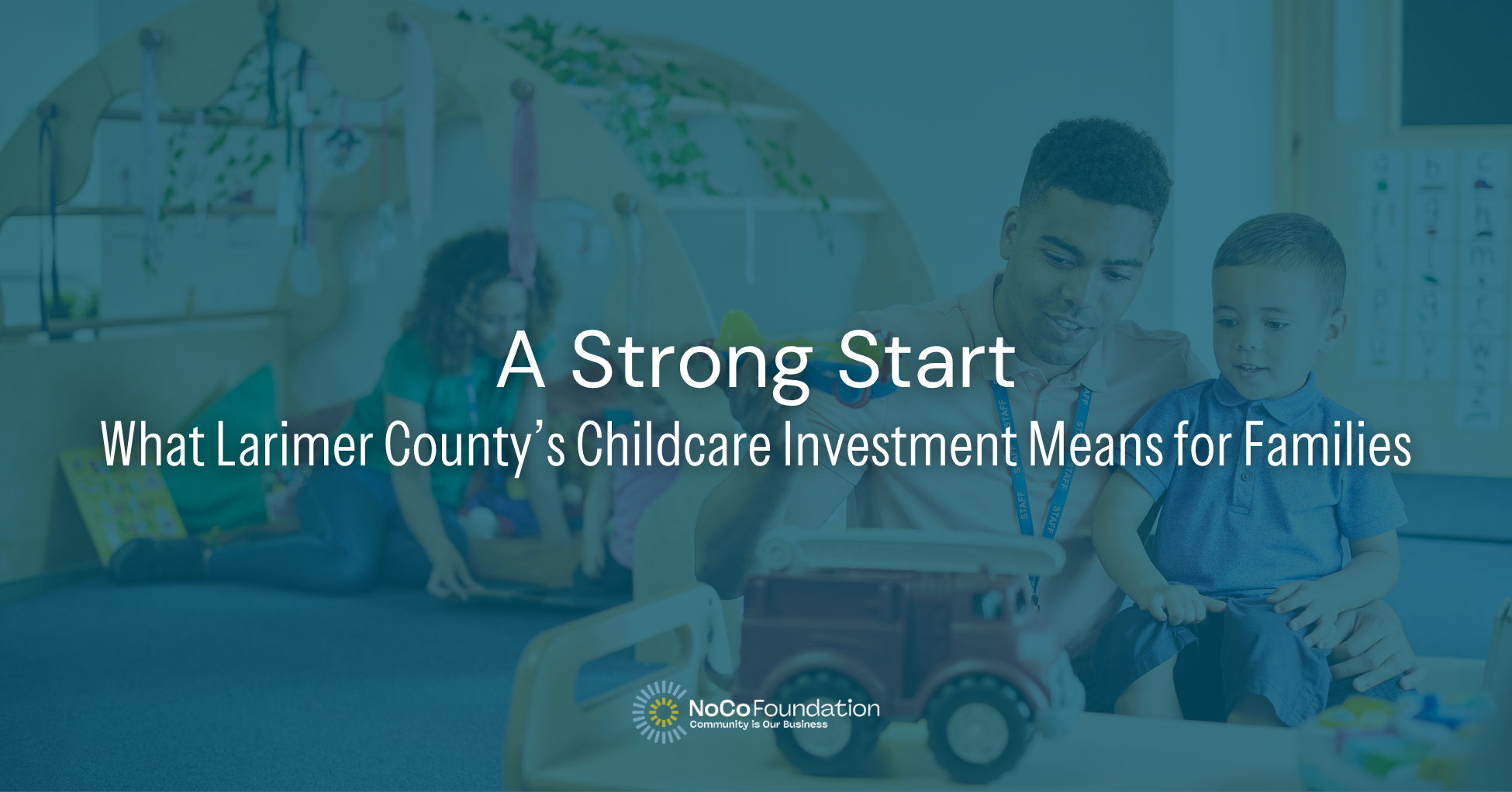
Listen to the full conversation on NoCo Voices: Conversations with neighbors strengthening Northern Colorado: "A Strong Start: What Larimer County's Child Care Investment Means for Families."
Learn more about Northern Colorado Kids Thrive and follow Larimer County Human Services for program updates.
Explore the 2024 Northern Colorado Intersections Report: Pursuing Regional Well-Being to learn more about the connections shaping quality of life across our region.