By Kristin Todd, President & CEO, NoCo Foundation
What does community well-being look like?
It’s a question the NoCo Foundation has been exploring through its Intersections work, an ongoing effort to better understand how the challenges and opportunities shaping Northern Colorado are connected.
Sometimes the answer can be found in data.
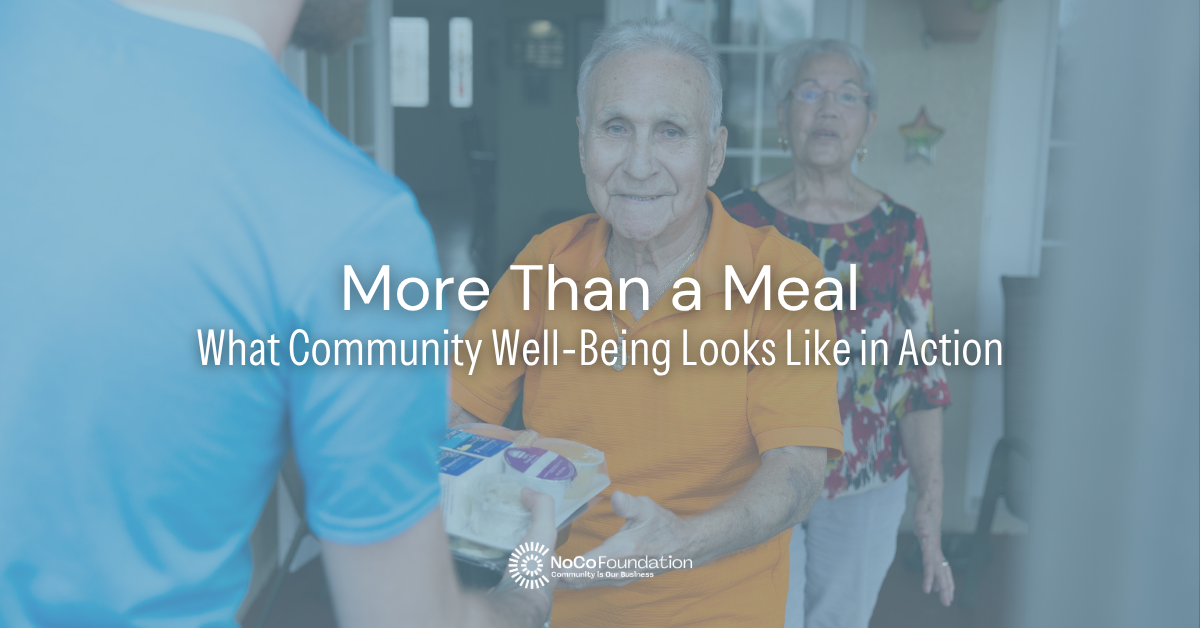
And sometimes it can be found at a front door, when a volunteer delivers a meal and spends a few minutes checking in with a neighbor.
That was one of the themes explored in a recent episode of the NoCo Voices podcast featuring Jeffrey Pomranka, Executive Director of Meals on Wheels of Loveland and Berthoud. While many people know the organization for delivering meals to older adults and homebound residents, Jeff shared a broader story, one that illustrates exactly what the NoCo Foundation means when we talk about intersections.
Looking Beyond a Single Issue
Our Intersections initiative is built around a simple but powerful idea: community challenges don’t exist in isolation. Housing, health, economic opportunity, social connection, food access, and mental well-being are all interconnected. Understanding those connections helps communities identify more effective ways to improve quality of life for everyone.
Meals on Wheels of Loveland and Berthoud provides a powerful example.
At first glance, the organization’s mission appears straightforward: provide nutritious meals to people who need them.
But a closer look reveals something much larger.
Each delivery helps support health and nutrition. It also creates a moment of human connection. It helps combat loneliness. It provides reassurance that someone cares. It creates opportunities for volunteer engagement. And in some cases, it serves as a bridge to additional support and resources.
One service touches multiple dimensions of community well-being.
That’s an intersection.
The Importance of Connection
Throughout the podcast conversation, Jeff returned to a theme that often receives less attention than food access or healthcare: social connection.
Research continues to show that isolation can have significant impacts on physical and mental health. Yet connection is often difficult to measure and easy to overlook.
Meals on Wheels sees its value every day.
For some clients, a volunteer’s visit may be among the most meaningful interactions they experience during the week. But the impact isn’t limited to those receiving services.
Jeff shared that volunteers frequently arrive early to the Meals on Wheels kitchen to pick up their daily deliveries, simply to spend time together before heading out on their routes. Friendships form. Relationships deepen. A sense of belonging develops.
In other words, the organization isn’t just delivering meals. It’s creating community.
And community matters.
Building Opportunity Alongside Service
Another example of the Intersections approach can be found inside the Meals on Wheels kitchen.
The organization provides opportunities for young adults with intellectual and developmental disabilities to build workplace skills and gain valuable experience. Through hands-on learning and mentorship, participants develop confidence, strengthen job readiness, and contribute meaningfully to the organization’s mission. It’s a win for everyone involved: students gain meaningful workplace experience, while meal recipients benefit from meals that include freshly prepared produce rather than frozen vegetables.
Again, the impact extends beyond a single outcome.
A workforce development opportunity becomes a pathway to greater independence. A community service organization becomes a place of learning. And a meal program becomes a catalyst for economic participation, inclusion, and healthier meals.
When viewed through an Intersections lens, these outcomes are not separate, they’re connected.
Why Community Organizations Matter
Across Northern Colorado, nonprofit organizations create countless opportunities for people to connect, contribute, learn, and thrive.
Some organizations focus on food security. Others address housing, education, mental health, environmental stewardship, workforce development, or the arts. Yet many of the most impactful organizations create benefits that extend far beyond their primary mission.
They build relationships.
They create volunteer opportunities.
They strengthen social networks.
They help people develop skills and confidence.
They foster belonging.
The nonprofit sector is critical infrastructure for community well-being. Nonprofit organizations help create the conditions that allow people and communities to flourish. As Northern Colorado continues to grow and evolve, that role becomes increasingly important. Strong communities depend on more than services alone. They depend on trust, relationships, and opportunities for people to engage with one another in meaningful ways.
A Regional Opportunity
One of the key lessons from the Intersections work is that the challenges facing Northern Colorado don’t stop at county lines. The opportunities don’t either.
Whether we’re talking about food access, workforce participation, social connection, housing, or health, the future of community well-being depends on our ability to work together across sectors, organizations, and communities. The Intersections initiative was designed to encourage exactly that kind of collaboration.
Organizations like Meals on Wheels of Loveland and Berthoud remind us that meaningful change often happens in unexpected places.
A meal becomes a conversation.
A volunteer shift becomes a friendship.
A kitchen becomes a classroom.
A community challenge becomes an opportunity for connection.
And when we begin to see those connections, we begin to see what community well-being truly looks like.
Listen to the full NoCo Voices episode, “More Than a Meal: Connection, Community, and the Power of Intersections,” featuring Jeffrey Pomranka, Executive Director of Meals on Wheels of Loveland and Berthoud.
To learn more about the NoCo Foundation’s Intersections work, explore the 2024 Intersections Report, Pursuing Community Well-Being and discover how collaboration, connection, and shared understanding can help strengthen community well-being across Northern Colorado.